

Is it Wood Rot or Just Surface Decay?
The Paintwright’s Guide to Diagnosing and Saving Your Cape Ann Home
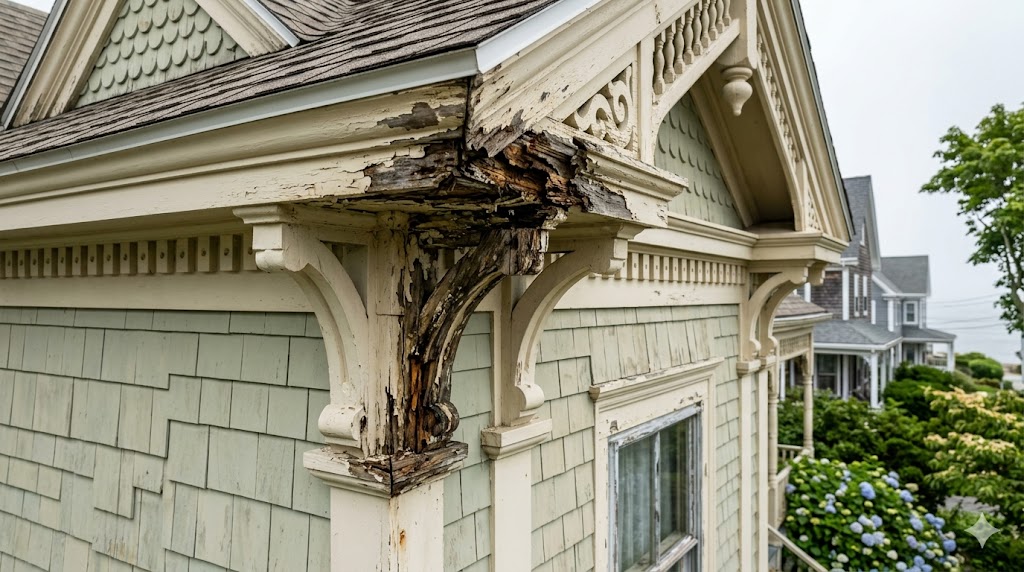
Original 18th and 19th-century old-growth millwork is a superior, high-density material that can often be saved through surgical intervention — even when it looks beyond repair. What appears to be wood rot is frequently a failed coating system, not structural decay.
Understanding how to accurately evaluate the state of your trim is the first step toward preserving your home’s architectural signature: if the probe meets resistance, the heartwood is likely salvageable.
The “Pick Test”: Assessing Your Home’s Envelope
Before assuming a cornice or water table is lost, a technical condition assessment separates aesthetic failure from structural decay.
- Surface Peeling: Often, what looks like rot is simply a failed coating system that has “alligatored” due to thermal cycling.
- The Density Test: Using a specialized probe, we check the internal fibers of the wood. If the probe meets resistance, the “heartwood” of your old-growth trim is likely salvageable.
- Fungal Indicators: The presence of black algae or moss on a gable indicates a moisture micro-climate that needs to be resolved, but does not always mean the wood has failed.
In neighborhoods like Annisquam and Magnolia, where Victorian cornices and decorative gable trim are architectural signatures, this diagnostic step is what separates a responsible restoration from an unnecessary demolition.
The dense old-growth timber on these homes is irreplaceable — the evaluation is always worth doing before writing it off.
Restoration vs. Replacement: The “Surgical” Choice
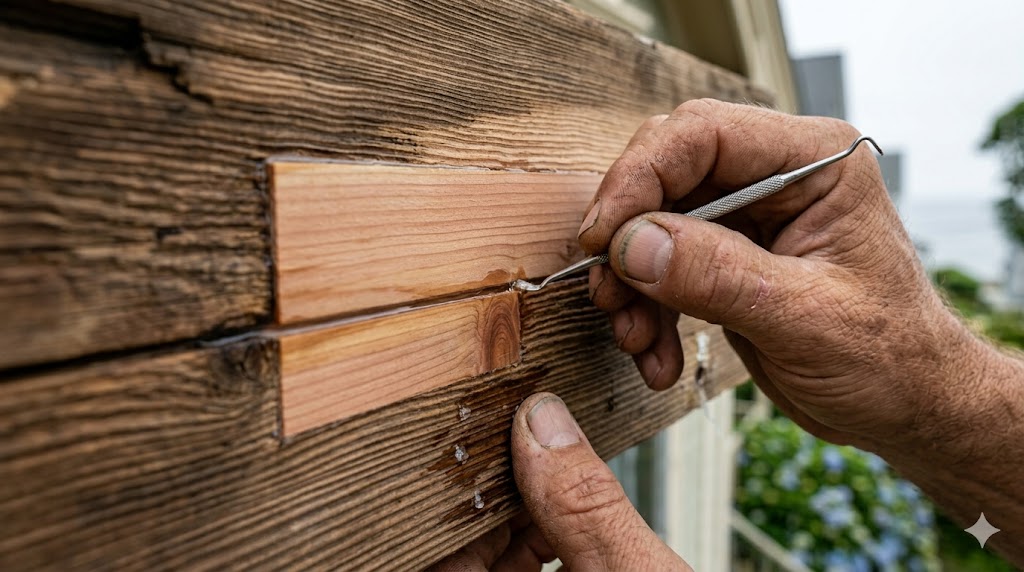
When localized decay is found, the Paintwright Standard is to utilize surgical carpentry rather than wholesale demolition.
- Surgical Composite Grafting (The Modern Dutchman): We surgically remove only the rotted section and graft in new wood segments that match the original grain and profile.
- Resin Stabilization: We use high-performance epoxy resins to rebuild intricate trim profiles where milling is not feasible.
- Moisture Source Control: We identify and correct underlying issues to ensure repairs last.
📌 Related:
Window Sill Rot Repair
What Can I Do to Stop My Waterfront House From Rotting?
Frequently Asked Questions: Wood Rot & Technical Repair
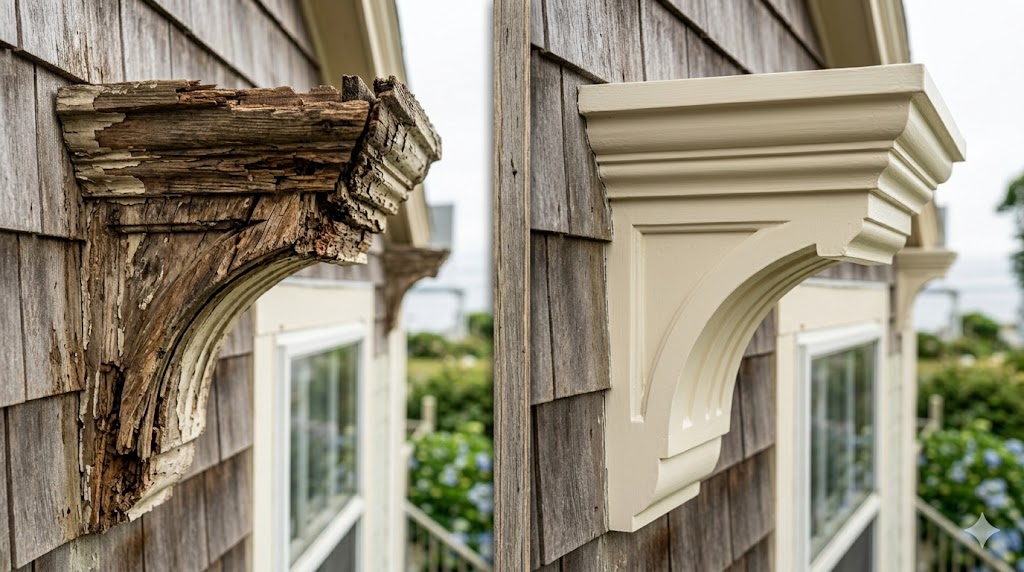
Is modern PVC better than original wood?
While PVC doesn’t rot, it expands and contracts at a different rate than the house, often leading to gap failures. Original old-growth wood is more stable and preserves the authentic read of a historic property.
Can you fix a rotted window sill without replacing the whole window?
Yes. Through surgical wood-to-wood grafting and resin reconstruction, the sill and sash can be stabilized without full replacement.
What happens if I ignore localized rot?
Moisture will travel behind the envelope and eventually reach structural framing, leading to significantly more expensive repairs.
Ready to Talk with a Local Exterior Restoration Professional?
If you have discovered soft wood or failing paint on your property, a technical evaluation is the only way to ensure your home remains weather-tight.
Request a Consultation