

What Can I Do to Stop My Waterfront House From Rotting?
How Preservation Specialists Protect Historic Coastal Homes From the Inside Out
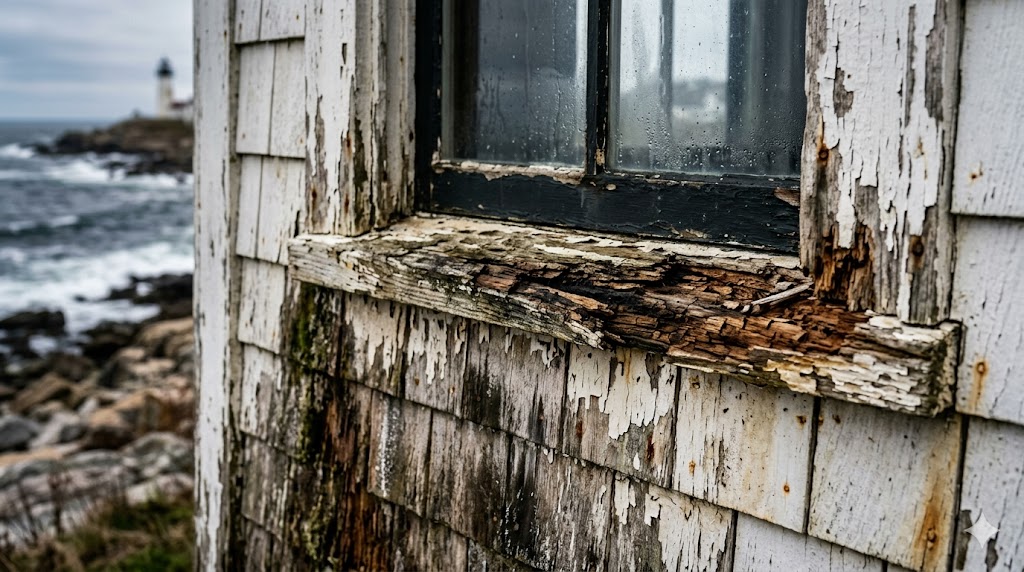
Rot on a waterfront historic home is almost never random — it is a moisture management failure. Historic homes were built with old-growth wood designed to breathe and release vapor naturally. When modern film-forming paints are applied over that wood, they seal moisture inside rather than letting it escape, accelerating decay from within. Stopping rot requires restoring the wood’s ability to manage vapor: removing failed coatings, treating active rot with consolidants, sealing with breathable finishes, and addressing the high-moisture zones where salt air and water intrusion concentrate. More paint is rarely the answer. The right system, applied correctly, is.
Where does rot typically start on a waterfront house?
Rot follows moisture, and moisture follows gravity and exposure. On a waterfront home, the highest-risk zones are predictable: the lowest siding courses closest to grade, beneath window sills where water pools and wicks into end grain, at inside corners where two walls meet and trap humidity, and on north- and ocean-facing elevations that receive the most direct salt spray and the least drying sun.
Expert Context for Homeowners:
On properties along Eastern Point and Land’s End — where nor’easters drive salt-laden moisture into every seam and corner — we consistently find that rot originates at the same anatomical points on nearly every historic home. The wood itself is often still sound in protected zones. Identifying and addressing the specific failure points surgically, rather than treating the whole envelope as compromised, is what separates a preservation approach from a replacement sales pitch.
Is it too late to restore rotting wood, or does it need to be replaced?
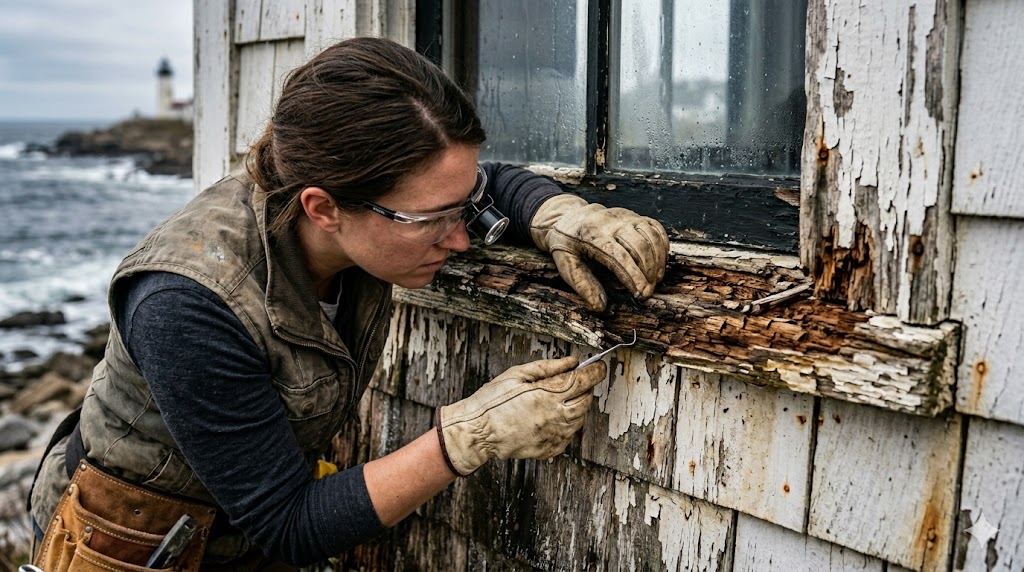
It depends entirely on whether the rot is surface-level or structural. Wood that has softened but still holds its form can often be stabilized with epoxy consolidants that harden the remaining fibers and accept paint or sealant normally. Wood that has collapsed structurally — that compresses under light finger pressure or crumbles — needs surgical replacement. The key word is “surgical.” A skilled preservation contractor replaces only what has genuinely failed, matching grain direction, exposure depth, and profile to the surrounding original material.
This distinction matters most on homes in Conomo Point and Bass Rocks where original old-growth timber — dense, tight-grained, and naturally more rot-resistant than anything milled today — is still largely intact. Replacing sound old-growth wood with modern fast-growth lumber because it “looks tired” is a downgrade, not an improvement. The goal is always to save what’s salvageable.
📌 Related: Window Sill Rot Repair
Why do waterfront houses rot faster than homes a few streets inland?
Salt is hygroscopic — it actively attracts and holds moisture against whatever surface it settles on. On a home a few streets inland, wood dries between rain events. On a waterfront property, salt deposits from daily spray and fog keep the wood surface damp far longer, compressing the moisture cycle and giving rot fungi the sustained wet environment they need to establish.
The second factor is thermal cycling. Direct sun on a salt-damp surface creates rapid expansion and contraction that opens micro-cracks in any coating. Those cracks let more moisture in, which carries more salt deeper into the grain.
Our Professional Standard for Waterfront Historic Homes
- De-salting Wash: Removing salt crystal buildup before coating
- Consolidant Treatment: Stabilizing softened wood fibers
- Breathable Finish Selection: Using high-perm coatings
- Surgical Carpentry: Replacing only failed sections
📌 Related: Is it Rot or Just Weathering? How to Evaluate Cedar Shingle Failure
Ready to Talk with a Waterfront Preservation Specialist?
If your waterfront home is showing signs of rot, peeling, or accelerated deterioration, the worst thing you can do is wait — and the second worst is to apply more of the wrong product.
Request a Consultation